What is a Haiku? A Beginner’s Guide to Understanding and Writing Poems
English Learning For Beginners: Learn All About Haiku Poetry
Have you ever tried to capture a beautiful moment in just a few words? Maybe you saw a stunning sunset, or a playful dog?
That’s exactly what a haiku does. It is a tiny, three-line poem that captures a moment of time. See? It’s that simple.
Even if you are just starting to use easy English speaking courses, haiku poetry is a wonderful way to practice. It doesn’t use big, complicated words. Instead, it focuses on your simple feelings and the world around us.
In this guide, you’ll learn:
- What is a haiku?
- A haiku history
- The true rules of a haiku
- How to write your own haiku
What Is a Haiku?
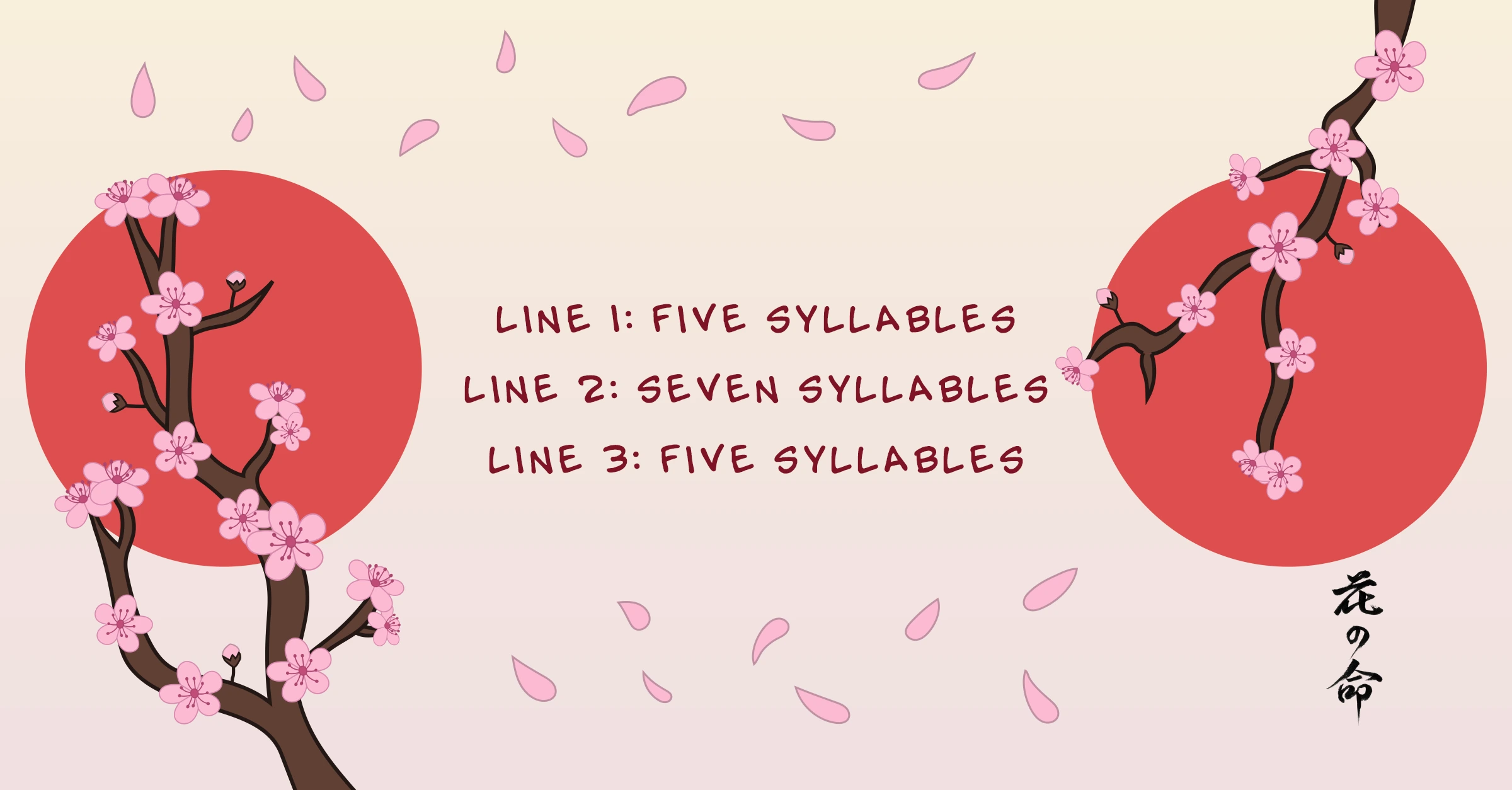
A haiku is a traditional Japanese poem. It is very short with only three lines. People often say a haiku must have 17 syllables.
That’s 5 in the first line, 7 in the second, and 5 in the third line. This is called the 5-7-5 pattern. This is a great starting point for beginners.
However, Japanese sounds are shorter than English, so many poets use fewer syllables in an English haiku.
Luckily for you, the most important thing about a haiku is not the syllable count. It is about capturing a single moment in time.
A Haiku History
Haiku started a very long time ago in Japan, but it wasn’t always a stand-alone poem.
In the 13th century, haiku was just the opening part of a much longer poem called a renga. One person wrote a short starting verse, then the next person added to it, and so on. That starting verse was called a hokku.
Over time, people loved the hokku so much that they started writing them on their own. Then, in the 17th century, a famous poet named Matsuo Bashō made this short form very popular. He is still the most famous haiku master today.
The True Rules of Haiku
To write a good haiku, you only need to remember a few simple things.
1. Kigo: Seasonal Words
A kigo is a word or phrase that hints at a specific season. When you say “cherry blossoms”, your reader instantly thinks of spring. Traditional haiku are about the natural world, so they often include a kigo to connect the poem to a time of year.
A kigo can have:
- Animals: Bird, snail, butterfly
- Weather: Snow, summer rain, autumn wind
- Plants: Cherry blossoms, sunflower, autumn leaves
- Human events: Christmas, fireworks, New Year
Here are some examples of kigo by season:
- Spring: Cherry blossoms, green leaves, spring rain, frog
- Summer: Beaches, sunshine, watermelon, popsicle
- Autumn/Fall: Falling leaves, pumpkins, harvest moon, cinnamon
- Winter: Cold, snow, soup, scarf, glove
A good kigo always brings a feeling with it. For example, “popsicle” means summer and it brings memories of sticky fingers, and hot summer days.
2. Use Juxtaposition and/or Kire
A haiku often places two different pictures side-by-side. This creates a little spark of surprise in your mind. This is called juxtaposition.
Now, here’s where it gets interesting, there is also something called kire. Kire means “cut” or “cutting” in Japanese. It is the pause or break between the two images in a haiku.
Think of it like this:
- Juxtaposition is the two different pictures sitting next to each other.
- Kire is the pause between them, where your mind goes from one picture to the other.
So they work together, but they are not the same thing.
In English, we often show kire with punctuation:
- A dash (-)
- An exclamation mark (!)
- A question mark (?)
- A colon (:)
- Or even just a line break
Example of Juxtaposition and Kire:
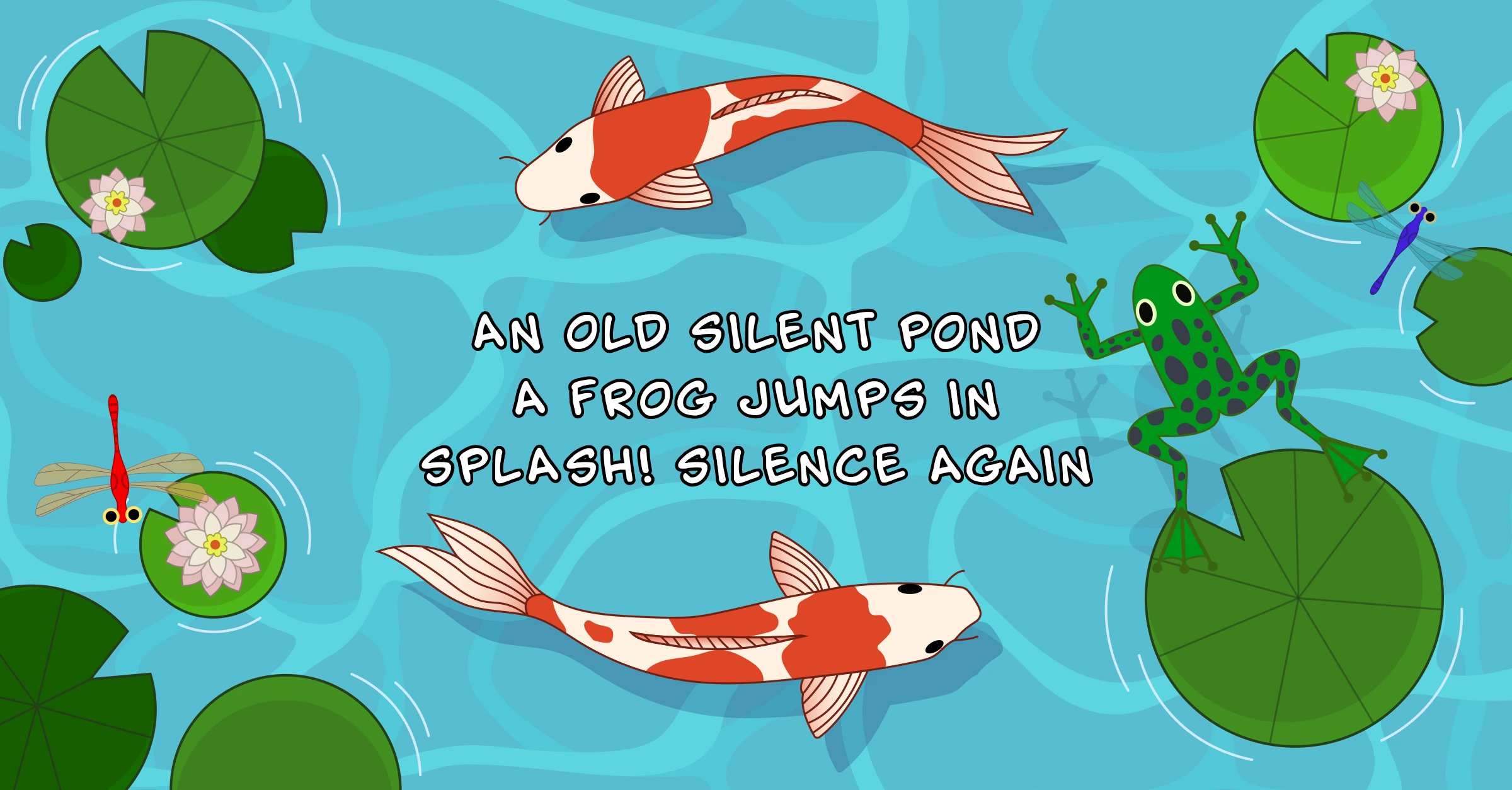
An old silent pond-
a frog jumps in,
splash! Silence again.
— Matsuo Bashō
Answer:
- Juxtaposition: The silent pond and the jumping frog.
The silent pond vs. the loud splash that the frog makes are the two differences placed right after each other.
- Kire: The dash (-) after “pond” creates a pause. The exclamation mark after “splash!” is another pause.
The kire helps you to connect the two images while giving you space to feel the surprise of the next line. Without the cut, the poem would just be boring and flat.
3. Present Tense
A haiku is most likely in the present tense, so it happens right now. The present tense puts the reader right there, seeing what the writer sees.
4. Leave the “I” Out
In a haiku, the poet does not talk about themselves. You are the observer, not the main character of the poem. It is about what you see, not about what you’re thinking.
Using “I” in haiku is not encouraged. This includes personal pronouns such as “he”, “she”, “we”, and “you”.
Example:
I see the old pond-
Instead use:
The old pond-
When “I” is used, the poem becomes about the “I” and not the moment itself. When you leave the “I” out, the reader becomes the observer and sees the “old pond” for themselves in their mind.
5. No Rhyme
It’s simple. There is no need to find words that rhyme.
How to Write Your Own Haiku
1. Go Outside or Look Out a Window
Find something that grabs your attention. Look at nature, at a tree, or a bug. What is it doing? What can you see, hear, smell, feel, or taste?
2. Write Down Exactly What You See
Write exactly the way you speak. For example: “There is a quiet, old pond and in the pond is a frog that jumped into the water. There was a splash, and then the pond was quiet again.”
3. Find a Kigo
Add one word that tells us the time of year because it helps the reader feel the season. For example, “frog” is a kigo for spring. It helps you to picture the spring season in the poem.
4. Cut It Down
Take away any extra words and only keep the words that create a picture. Anything that isn’t an image can go.
An old silent pond-
a frog jumps in,
splash! Silence again.
5. Read It Aloud
Reading your haiku aloud helps you hear the rhythm. Does it create a picture in your mind? Does the juxtaposition create strong imagery? Does it flow naturally?
Conclusion
A haiku teaches you to slow down, notice small things, and say more with less. That is exactly why haiku works so well for English learners. Because a haiku shows us that poetry does not need complex words.
Want to learn more? Read how English speaking and writing doesn’t need to be too complex: How to make your English writing sound more sophisticated without using difficult words.
Many English speaking courses focus on building confidence, and the haiku does the same thing. Enjoy using this haiku guide to create a safe space to play around with words.
You got this!
References
- Definition of a Haiku
- The History and Artistry of Haiku
- Want to learn more about Kigo?
- Definition of Juxtaposition
Written by: Caitlin-Rose Esau