English Learning For Beginners: English Word Roots and Word Structure
English Learning For Beginners: English Word Roots and Word Structure
Want to take your English learning to the next level? It’s time to learn about English word roots and word structure!
It’s not as complicated as it seems. Wherever you are in your English learning journey, learning about English root words will help you recognize patterns in the language and streamline your language learning.
Being able to identify root words and knowing their meanings can help you figure out the meaning of a new word, even without a dictionary.
In this article, we will learn:
- What Are Root Words?
- Languages of Origin
- Common Latin Root Words
- Common Greek Root Words
- Prefixes
- Suffixes
- Frequently Asked Questions
What Are Root Words?
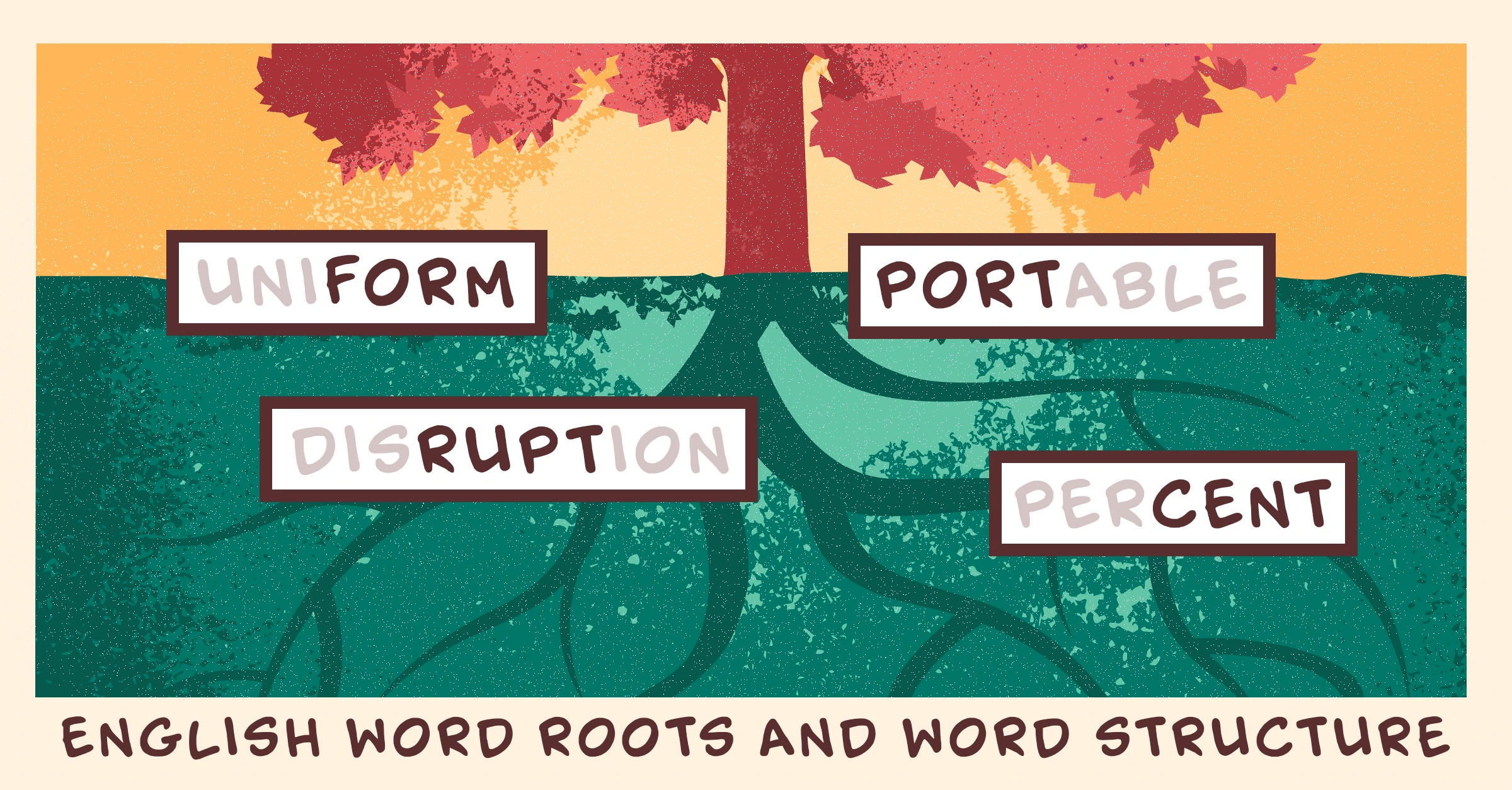
So, what is a root word? A root word is the core part of a word that carries its main meaning and can’t be broken down into smaller segments or smaller word parts.
Root words are combined with other root words or with prefixes/suffixes to create new words. (More on those later!)
What do the words “aquarium”, “aquatic”, “aquamarine” have in common? All three of them share the same root word, “aqu”, which means “water”. What makes them different words are the parts added to the root word.
Languages of Origin
English, like many languages, is based on a lot of different old languages and borrows from many of them. 60% of English words come from Latin and Greek root words. In this article, we will focus on root words from these two languages.
Most Latin and Greek root words like “bio”, “hydr”, and “phon”, need to be combined with prefixes or suffixes to make sense. Sometimes, root words can also be prefixes or suffixes.
Below are some examples of root words, their meanings, and how they can be used:
Common Latin Root Words
| Root Word | Meaning | Word Examples |
|---|---|---|
| anim(a) | Soul | Animate, animal, unanimous |
| cent | One hundred | Century, percent, centurion |
| port | To carry | Portable, transportation, export |
| rupt | To break | Bankrupt, disruption, rupture |
| spect | To look | Inspect, spectator, perspective |
| aqu | Water | Aquarium, aquatic, aquamarine |
| audi | Hear | Audible, audience, auditorium |
| manu | Hand | Manual, manicure, manipulate |
| vac | Empty | Vacuum, vacate, evacuate |
| sens | To feel | Sensitive, sentient, senses |
| terr | Earth | Terrain, territory, extraterrestrial |
| brev | Short | Abbreviation, brief, brevity |
| carn | Meat or flesh | Carnivorous, carnage, reincarnation |
| cred | To believe/trust | Incredible, credentials |
| magn | Great, large | Magnificent, magnify, magnanimous |
Common Greek Root Words
| Root Word | Meaning | Word Examples |
|---|---|---|
| dem | People | Democracy, epidemic, demographic |
| scope | To look at/examine | Microscope, telescope, kaleidoscope |
| hydr | Water | Hydration, hydraulic, dehydrate |
| chron | Time | Chronicle, synchronize, chronological |
| photo | Light | Photograph, photosynthesis, photon |
| therm | Heat | Thermal, thermostat, thermometer |
| log | Word, reason | Logic, catalog, dialogue |
| geo | Earth | Geology, geography, geode |
| ast(er) | Star | Asteroid, astronomy, astronaut |
| phon | Sound | Phone, phonograph, telephone |
| gen | Birth, race | Generate, genetic, genealogy |
| auto | Self | Automatic, autobiography, autofocus |
| chrome | Color | Monochrome, chromatic, chromosome |
| psych | Soul/spirit | Psychology, psychic, psychiatrist |
| tele | Far | Telephone, television, telescope |

Affixes
Affixes are parts of a word added to the beginning or the end of the root word to change its meaning.
Prefixes are added to the beginning of the root word:
For example, dis- is added to agree to make the word disagree.
Suffixes are added to the end of the root word:
For example, -less is added to home to make the word homeless.
Here are some common prefixes and suffixes:
Prefixes
| Prefix | Meaning | Example |
|---|---|---|
| un- | Not/opposite | Unhappy, undo, unforgettable |
| re- | Again | Restart, replay, redo |
| im- / in- | Not | Impossible, invisible, incomplete |
| mis- | Wrongly, error | Mislead, misplace, misunderstand |
| semi- | Half, partly | Semifinal, semisweet, semicircle |
| sub- | Under | Subway, submarine, subzero |
| micro- | Very small | Microscope, microchip, microwave |
| mid- | Middle | Midfield, midday, midwinter |
| trans- | Across, change | Transmit, transatlantic, transform |
| dis- | Not | Disrespect, disappointed, distrust |
Suffixes
| Suffix | Meaning | Example |
|---|---|---|
| -logy | Study | Biology, psychology, geology |
| -est | Superlative (most) | Biggest, strongest, tiniest |
| -al | Relating to | Annual, comical, biological |
| -able | Having the quality of | Comfortable, portable, breathable |
| -er | Comparative | Bigger, stronger, greater |
| -ful | Full of | Respectful, helpful, hopeful |
| -ity | State of | Activity, society, reality |
| -graph | To write or draw | Photograph, autograph, telegraph |
| -ment | State of being | Contentment, sentiment, agreement |
| -ion, -tion | Act, process | Edition, condition, information |
Frequently Asked Questions
I noticed some Latin and Greek root words mean the same thing. Why is that?
Answer: You may have noticed that the Latin root word, “terr”, means the same thing as the Greek root word, “geo”. Both of them mean “earth”. Similarly, you may have noticed that “audi” and “phon” are both related to sound.
The English language, like many other languages, has developed over a very, very long time and has been influenced by a lot of different regions at different times. Many words that sound different can mean the same things, and words that sound the same can mean different things. It’s just part of the nature of language, and that is why language is beautiful!
How is learning about root words and word structure useful for learning English?
Answer: Knowing what root words and word structure can help you figure out what new, difficult words mean and remember words better.
For example, knowing that the suffix “-logy” means “the study of” can help you figure out the meaning of most words ending with that suffix.
If you know root words like “bio” and “geo”, then you can figure out what “biology” and “geology” mean. Knowing the root word and suffixes also help you remember how to spell the words.
What languages are English rooted in?
Answer: 60% of English vocabulary has roots in Latin and Greek. Around 25% of English is based on Germanic, also known as Old English. The rest of the English language has roots in or is borrowed from other languages like French, Celtic, and German.
How else can I improve my English vocabulary?
Answer: Depending on your goals, there are many things you can do to improve your English vocabulary. Here are some ideas:
- Read, read, read. The more you read, the more you will see and remember vocabulary.
- Learn with a teacher or tutor, whether through an in-person course or English speaking course online.
- Join English learning groups to learn with your peers.
Written by: Christina Liu