English Words That Get Mixed Up Easily
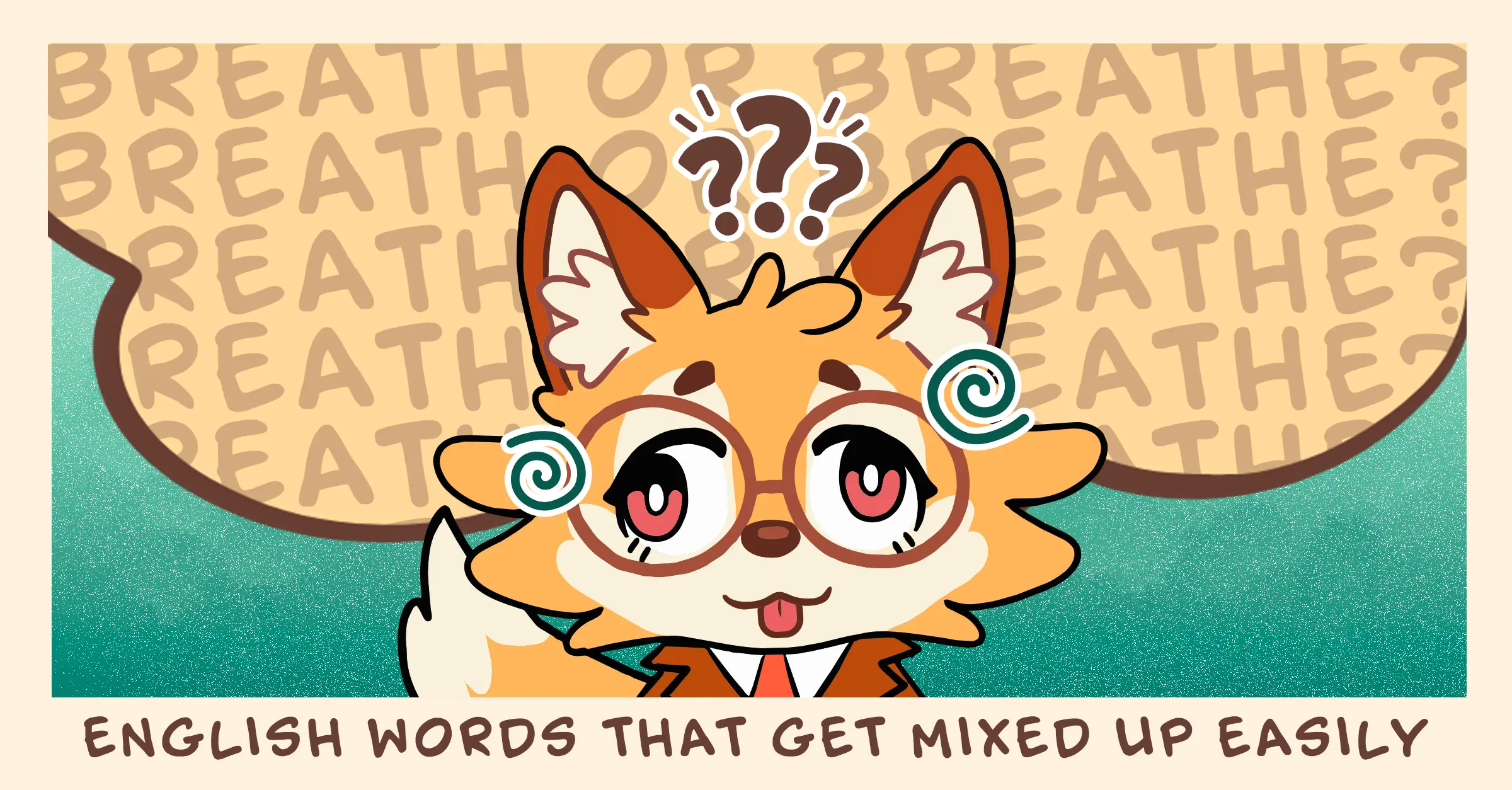
English words that get mixed up easily are more common than you think. What’s the difference between a compliment and a complement? Is it “could have” or “could of”? There are many words that beginner and advanced English learners can confuse or mix up easily.
In this article, we will go over some English words that get mixed up easily, including commonly confused, misused, and misspelled words.
English Words That Get Mixed Up: Commonly Confused
Some words sound very similar, or are spelled very similarly. It is easy to get them mixed up and use one when you mean to use the other. Keep an eye out for these because just one letter can change the whole meaning of your words:
1. Breath vs. Breathe
Breath and breathe are sometimes confused with one another. The key distinction is that one is a noun and the other is a verb.
“Breath” (noun) refers to the air that comes in and out of your lungs:
“I held my breath.”
“He let out a long breath after holding it for so long.”
“Breathe” (verb) is used as an action:
“I can’t breathe.”
“After coming out of the water, he could finally breathe.”
Tip: Pay attention to the letter “e” at the end — breathe (verb) ends in an “e,” breath (noun) does not.
2. Capital vs. Capitol
Capital and Capitol sound exactly the same when spoken out loud, so it is easy to mix up the spelling. The difference is that one word has many meanings, while the other is very specific.
Capital has several meanings:
The city that serves as the seat of government of a country or region (“The capital city of Canada is Ottawa.”).
Financial assets and resources (“Over the years, he built significant business capital.”).
Punishable by death: “capital punishment.”
Capitol, on the other hand, refers specifically to the building or group of buildings where a legislature meets. In the US, the Capitol (with an uppercase “C”) is the building in Washington, D.C., where Congress meets.
Memory tip: Capitol (building) has an “o” — think of the dome shape. Capital (everything else) has an “a.”
3. Compliment vs. Complement
Compliment and complement are often confused because they are pronounced nearly the same and spelled very similarly.
Compliment (with an “i”) means to praise or express admiration. It can be used as a noun or a verb:
“She complimented her coworker on his hard work.”
“He took the compliments with a big smile.”
Complement (with an “e”) means something that completes, goes well with, or pairs with something else:
“This wine perfectly complements that steak.”
“Your jacket complements your shoes.”
Note: Complimentary (with an “i”) means something given for free (e.g., “The hotel room comes with complimentary breakfast.”). Complementary (with an “e”) means things that go well together (e.g., “He used a lot of complementary colours in his painting.”).
4. Loose vs. Lose
Loose and lose are two words that get mixed up very often because they are spelled so similarly. However, they are pronounced differently and mean different things.
Loose (adjective) means something is not fixed firmly or not tight:
“The screws on my bicycle are loose.”
“Someone let all the goats loose on the field.”
Lose (verb) means you failed to win something or you cannot find something:
“I am not going to lose my competition tomorrow.”
“I always lose my wallet on the bus.”
Memory tip: Loose has two o’s — it’s a bigger word because it means something isn’t tight or contained.
Commonly Misused English Words That Get Mixed Up
In spoken or informal English, there are many words that are used incorrectly. Beginner English learners can easily adopt these misuses from native speakers. While these mistakes are common in casual language, using words correctly is important in professional settings.
1. “Could of” vs. “Could have”
“Could have” is often misspelled as “could of” because the contracted form “could’ve” sounds very close to “could of” when spoken.
Remember: The correct form is “could have” or the contraction “could’ve.” The phrase “could of” is always incorrect.
2. “On accident” vs. “By accident”
Some people incorrectly say someone did something “on accident” instead of “by accident.”
This misuse likely occurs because the opposite of “by accident” is “on purpose,” leading to the incorrect assumption that “on” is used for both phrases.
Remember: It’s “by accident” and “on purpose” — not the other way around.
3. “For All Intensive Purposes” vs. “For All Intents and Purposes”
“For all intents and purposes” is a phrase that is sometimes mistakenly said as “for all intensive purposes” due to mispronunciation or mishearing. The correct phrase means “in every practical sense” or “essentially.”
“For all intensive purposes” may seem logical, but it is the incorrect version of this idiom.
4. “E.g.” vs. “I.e.”
The Latin abbreviations “e.g.” and “i.e.” are easy to get mixed up. Here is what they mean:
“E.g.” stands for exempli gratia and means “for example.” Use it before listing possible examples from a larger set:
“I love sports, e.g., football, golf, swimming, and basketball.”
“I.e.” stands for id est, which means “that is” or “specifically.” Use it to clarify or rephrase something, not to list examples:
“He travelled to seven continents, i.e., all of them.”
Tip: If you can replace the abbreviation with “in other words,” use “i.e.” If you can replace it with “for example,” use “e.g.”
English Words That Get Mixed Up in Spelling
Below is a list of words that are often misspelled, even by native English speakers. Take note of the correct spellings:
Absence — Often misspelled as “abscence.”
Accommodate — Often misspelled with a missing “c” or “m.”
Believe — Often misspelled as “belive” or “beleive.”
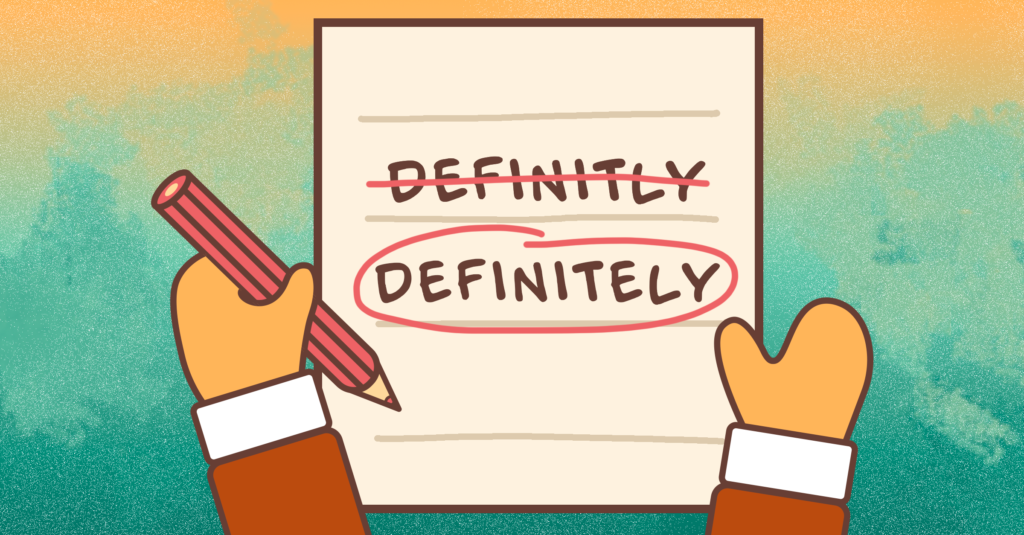
Definitely — Often misspelled as “definitly” or “definately.”
Diarrhea — Often spelled with letters out of order or missing an “r.”
License — Often misspelled as “lisence” or “lisense.”
Separate — Often misspelled as “seperate.” (Remember: there’s a “rat” in sep-a-rat-e!)
Privilege — Often misspelled as “priviledge.”
Pronunciation — Often misspelled as “pronounciation.” (Note: it’s not “pronounce” + “-iation.”)
Frequently Asked Questions
Q. Where can I learn more about correct English word usage?
Ans: There are many online resources available, including websites, blog posts like this one, English tutors, and online English language courses. Websites like Merriam-Webster (merriam-webster.com) and Grammar Girl are great starting points for looking up word definitions and usage.
Q. How can I better remember the proper spelling of commonly misspelled English words?
Ans: Try using spelling mnemonics — memory devices that make tricky words easier to remember. For example:
“I before E, except after C” helps with words like believe and receive.
“There’s a rat in separate” helps you remember sep-a-rat-e.
“Never beLIEve a LIE” reminds you of the “lie” inside believe.
You can also try writing words out multiple times, using them in sentences, or using flashcard apps like Anki to practice regularly.
English words that get mixed up can be tricky, but with practice and the right tools, you can master commonly confused, misused, and misspelled words. Bookmark this guide and refer back to it whenever you need a refresher. For more English learning tips, explore our other articles on englishlanguageandliterature.