Formal vs. Informal English: Understanding Tone and Register
Introduction
Have you ever worried about sounding too formal or too casual in a conversation? Have you ever felt like someone didn’t understand what you were trying to express?
These situations show that communication is about more than just the words we use. And that knowing what to say is important, but knowing how to say it matters just as much.
In this article, you will learn about tone and register, and the ways we can use them in day-to-day conversations. We will also share practical tips to help you communicate more naturally in different situations, a useful skill for English learners taking an English fluency course online.
What is the difference between tone and register?
Definition of tone: The quality in someone’s voice that expresses the person’s feelings or thoughts.
For example, talking to a friend who’s having a hard time (sympathetic and serious tone).
Definition of register: Often the level of formality in language used for specific situations.
For example, writing an email to your boss (formal register).
Remember! These also work together. When writing to your boss, you might use a formal register AND a friendly tone at the same time.
How does tone change the meaning of a sentence?
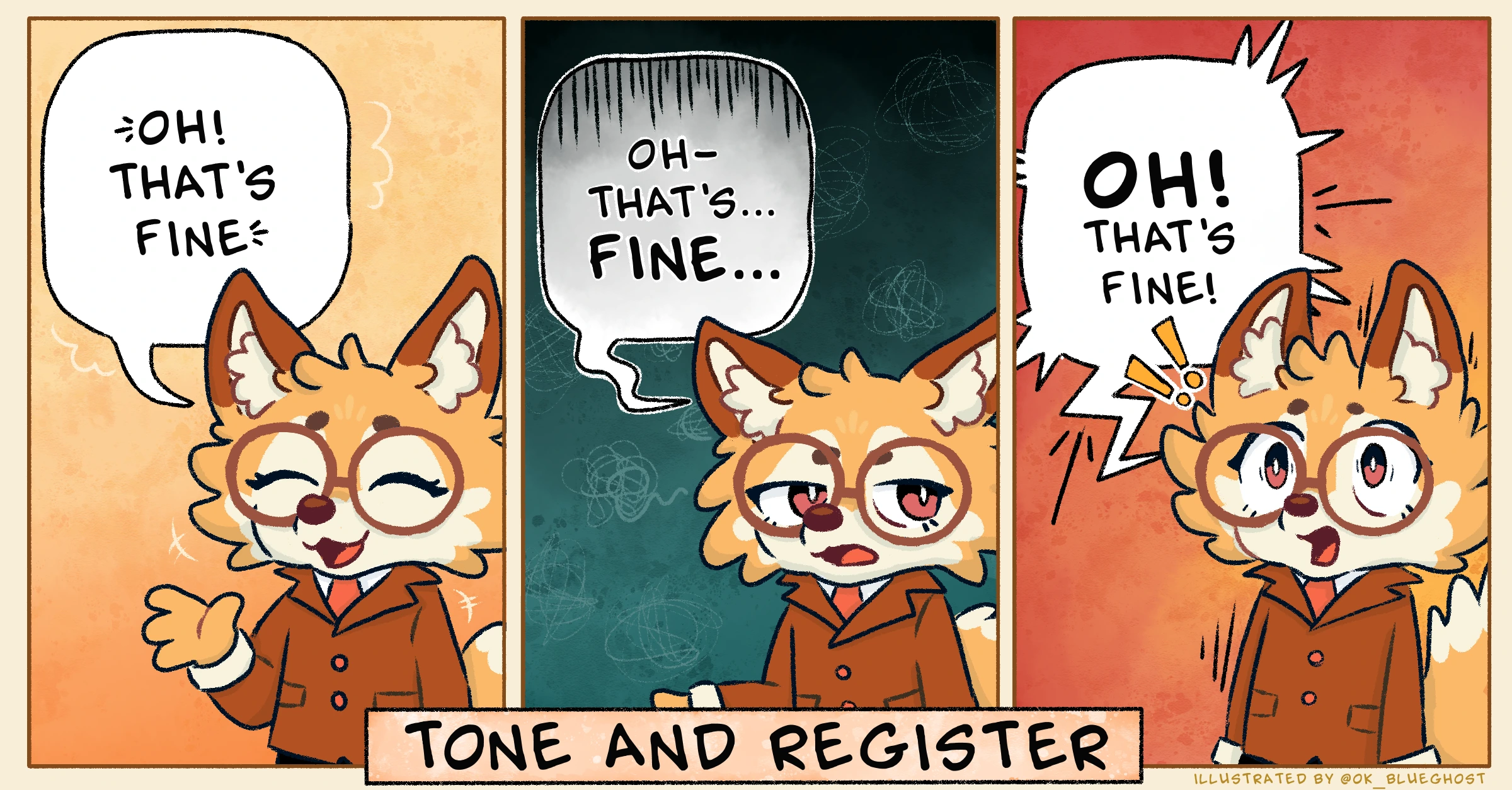
When we communicate, we express emotions through our tone. However, the tone we intend to use is not always the tone others understand.
For example, texting a friend “Hey! I have some news!” might sound cheerful. But writing “Hey. I have some news.” could make the same message seem worrying, even though both phrases are almost identical.
It is important to know some of the registers to avoid misunderstandings:
| Tone | Example | When should you use it? |
|---|---|---|
| Optimistic | “I’m sure everything will work out in the end!” | When you feel hopeful or expect a positive outcome. |
| Pessimistic | “I don’t think this will end well…” | When you expect a negative outcome. |
| Sarcastic | “Oh, great! Another problem to deal with!” | When you want to express irony or mock something. You often say the opposite of what you really mean. |
| Dry | “Oh. That’s cool.” | When you want to express yourself with little emotion. |
| Friendly | “Hey! It’s so nice to hear from you!” | When you want to sound welcoming and approachable. |
| Informative | “The meeting starts at 5 p.m. in Room 7.” | When you want to share facts or give clear instructions. |
| Persuasive | “Try it today and see the difference for yourself!” | When you want to convince someone to take action (e.g. ads). |
| Doubtful | “Are you sure that’s going to work?” | When you’re not fully convinced about something. |
Other elements can influence our tone during spoken communication. Intonation, facial expressions and body language all help convey emotions and change how our words are understood by others.
Understanding Register: Formal vs. Informal
Formal English
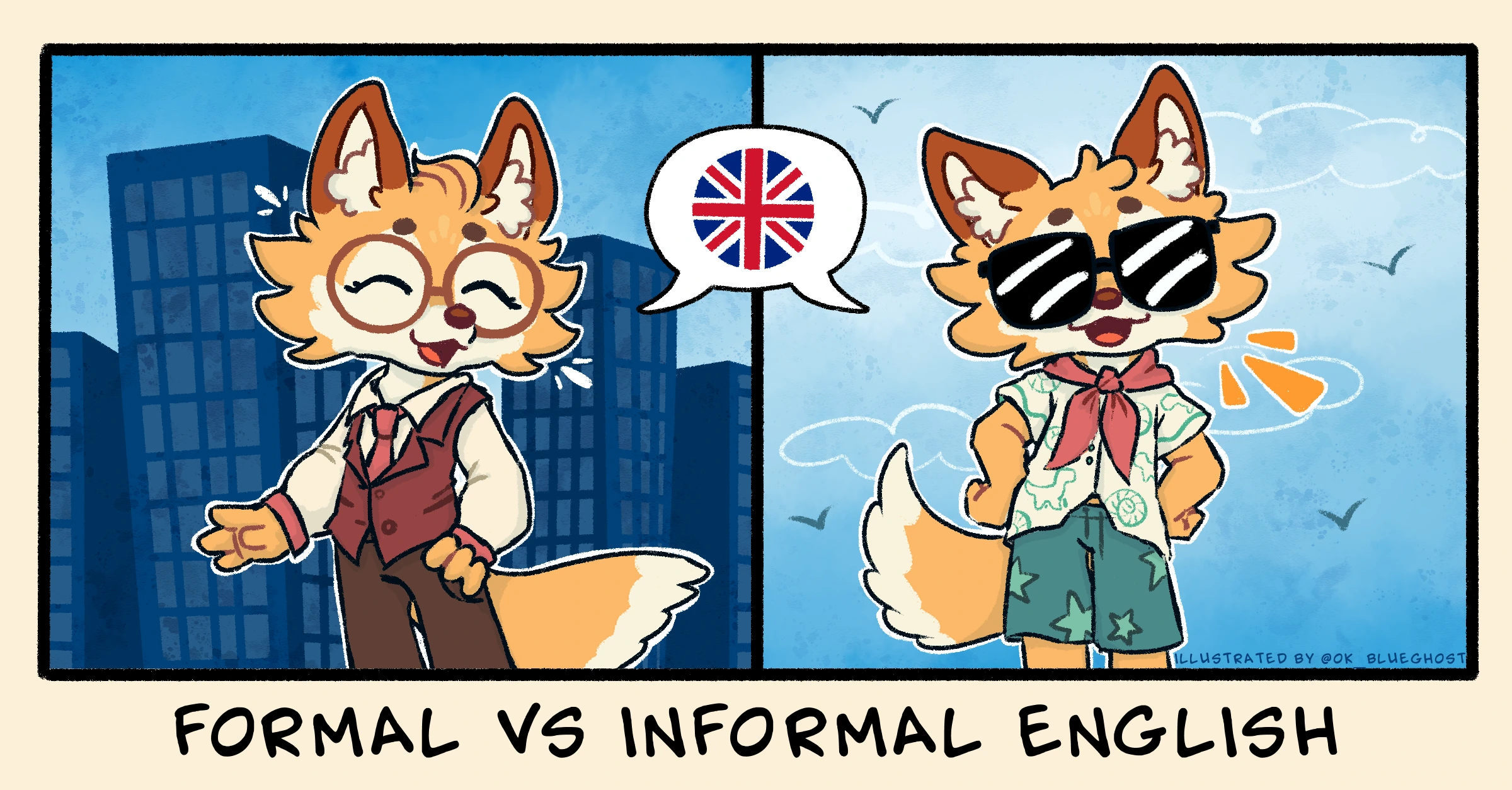
Formal register: The style of language used in professional, academic or serious settings.
When should you use this register? In job interviews, professional emails, academic essays, articles, job applications, formal speeches, etc.
Tips: Avoid using personal pronouns like I, You, We…, emotional language or contractions (gonna, wanna, gotcha). Use complete sentences with proper punctuation, and use single-word verbs rather than phrasal verbs.
Informal English
Informal register: The style of language used in social and relaxed settings.
When should you use this register? Talking to your friends or family, texting on the phone and on social media.
Tips: Use personal pronouns such as I, You, We…, emotional language and contractions (gonna, wanna, gotcha), as well as everyday vocabulary, slang or abbreviations.
What makes English sound formal or informal?
Formal and informal English use different language features. Here are some key examples to look out for when choosing the right register:
| Language element | Formal English | Informal English |
|---|---|---|
| Vocabulary | “I may need some additional information.” | “I think I need more info.” |
| Contractions | “I cannot make it to the meeting.” | “I can’t go to the meeting.” |
| Slang / abbreviations | “Thank you. I cannot check it at the moment but I will get in touch soon.” | “Thanks, ngl I’m too busy to check it right now.” (ngl = not gonna lie) |
| Greetings and requests | “Dear Mr Smith, Could you please send me the document? Thank you.” | “Hey John, can you send me the file? Thanks.” |
| Punctuation | “I look forward to hearing from you.” | “Talk to you soon!!” |
| Sentence structure | “I would like to ask you a question.” | “I just wanted to ask you something.” |
Remember that these are general suggestions rather than strict rules. Some features such as contractions can also appear in professional communication.
How can you improve your use of tone and register?
Becoming comfortable with different tones and registers takes time and practice. The more you read, listen and use English in different situations, the easier it will become to use it.
Here are some practical tips to help you get started.
Questions to ask before communicating in English
Before communicating, take a moment to think about the setting. This can help you choose a tone and register that suits your context best.
- Who am I communicating with? What is your relationship with the person? Is it a formal or an informal situation?
- What do I want to convey? Consider how you want the other person to feel or respond to your message.
- What do I want to say? What words and expressions can you use to communicate your message clearly and appropriately?
Ways to practice using different tones and registers
- Read different types of writing. Notice how vocabulary, sentence structure, and punctuation change because of the audience and the purpose. Ask yourself the three questions above from the author’s perspective.
- Listen to different types of media. Watch films or videos and listen to podcasts in English. Pay attention to intonation, facial expressions and body language.
- Rewrite messages. Try expressing the same idea in different tones or registers by changing each element we talked about. Notice how these changes can affect the way your message is understood.
- Speaking and feedback. Practise speaking English regularly and ask for feedback to improve. English speaking training online can also help you build confidence.
Final thoughts
The way we communicate can shape the way others understand us. That is why it is important to know that the same words can sound friendly, distant, professional, or even rude depending on our tone and register.
Learning to recognise these differences can help us express ourselves more clearly and confidently.
With regular practice, choosing the right words and tone become easier. So, keep in mind that everyday activities like chatting with friends, watching a movie or sending an email to a colleague are all great opportunities to improve your English.
Pay attention to how people communicate, watch how their expressions and words shift in every situation, and try expressing the same ideas in different ways.
Finally, whether you are learning English on your own or you’re planning on taking an English fluency course, remember that becoming a confident communicator is not just about learning the words, but also about learning when and how to use them!
Frequently Asked Questions
Q. Difference between tone and register.
A. Tone refers to the attitude or emotion you express while communicating, while register refers to how formal or informal your language is. Both help you adapt your communication to different situations, and both can be used at the same time.
Q. Difference between formality and informality.
A. Formal English is used in professional, academic or official situations using complete and polite expressions, while informal English is casual, and more common in conversations with friends and family. Neither is better than the other, but the right choice always depends on the context.
Q. Is British English more formal than American English?
A. No. Although British English often feels or sounds more formal than American English, both use formal and informal language. The level of formality depends only on the situation and audience, not the variety of English.
Q. How can I sound more formal in English?
A. Choose appropriate vocabulary, use complete sentences and avoid overly casual expressions. Speaking clearly and at a comfortable pace can also help you sound professional and confident.
Q. Why can learning tone and register be difficult?
A. Learning tone and register can be challenging for English learners because the language constantly changes depending on the setting and social expectations. There are no strict rules for every situation, so reading, listening, and practising with feedback are great ways to become more familiar with every tone and register.
Written by: Lisa