
How to Write A Strong Essay in English: A Beginner’s Guide
Expressing your opinion during a conversation is usually easy. But what happens when someone asks you to turn the same opinion into a 500-word essay? Suddenly, you need to think about structure, vocabulary, grammar… What seemed so simple when speaking has become a completely different challenge now!
The good news is that learning how to write an essay in English does not have to be difficult. With a little practice, you can learn to express your thoughts confidently without using complicated words.
In this guide, we’ll explore the basic essay structure and share practical writing tips to help you become a more confident writer!
What Makes an Essay Strong?
A strong essay is not about using complicated words or writing long sentences. It is about presenting your ideas clearly and supporting your arguments effectively.
Whether you are writing for school, preparing for an English examination, or developing your academic writing skills, a good essay should include:
- A clear central idea.
- A well-structured introduction.
- Appropriate vocabulary and grammar.
Once you understand these key elements, putting your thoughts into writing becomes much easier!
Understanding The Structure of an Essay
Although essays can vary depending on their type and purpose, many follow a simple three-part structure: an introduction, a main body, and a conclusion.
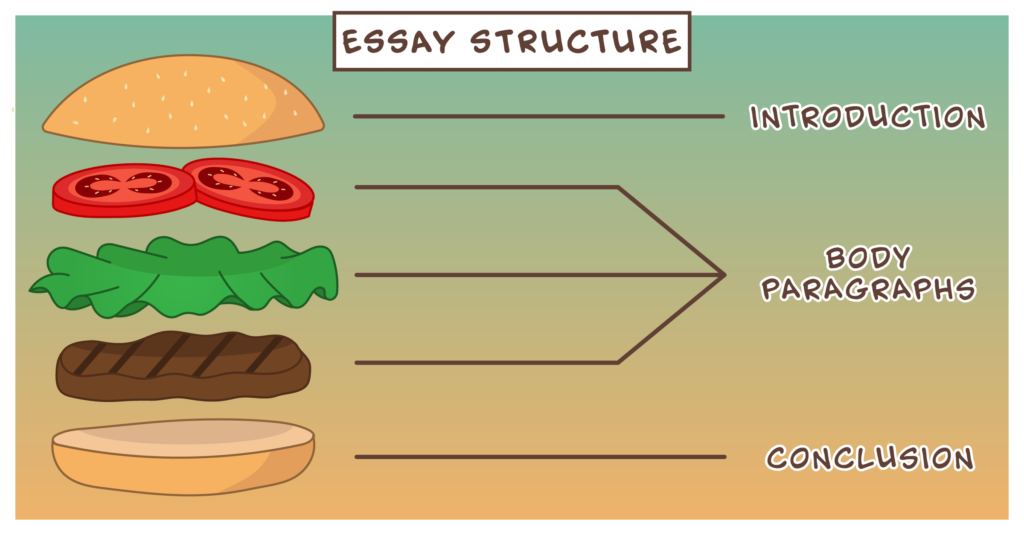
- Introduction
The introduction is the opening paragraph of your essay and sets the scene for everything that follows. Here, you present the topic, give the reader an idea of what you are going to talk about, and encourage them to keep reading.
In most essays, you may also include a thesis statement, which is a sentence that states your main argument or position on the topic.
Example:
“Homework has been an important part of education for many years, but while some people believe it helps students reinforce what they learn in class, others argue that it creates unnecessary stress. I believe it plays an important role in developing students’ knowledge and responsibility. Therefore, in this essay I will explore the benefits of homework and explain why I believe it should remain part of students’ education.”
- Body Paragraphs
The main body is where you develop your arguments and ideas in detail. Each paragraph should focus on ONE main point, explaining it and supporting it with relevant examples or evidence.
Example:
“One of the main benefits of homework is that it helps students reinforce what they learn in the classroom. By completing exercises and reviewing their notes at home, students have the opportunity to develop a better understanding of different subjects. For example, solving additional math problems can help students become more confident and improve their problem-solving skills. As a result, homework can support classroom learning and help students retain information more effectively.”
- Conclusion
The conclusion brings your essay to a close by summarising the main topics and reinforcing your central idea. Think of it as your final opportunity to leave the reader with a clear understanding of your message.
A good conclusion usually includes three elements:
- Restating the main argument: Express your thesis statement.
- Summarising the main points: Briefly bring together your arguments.
- Ending with a final thought: Include a recommendation, a personal reflection, or a border observation.
Example:
“To conclude, homework can be beneficial for students when it is used appropriately. It helps reinforce classroom learning, encourages responsibility, and allows students to develop independent study habits. Rather than removing homework completely, I believe schools should focus on setting meaningful tasks that support students’ learning without placing unnecessary pressure on them.”
Tips for Writing Each Part of an Essay
Now that you understand the basic structure of an essay, it is time to look at how to approach each stage of the writing process:
- Understand the Essay Topic
We’ll start by taking a moment to read the essay question carefully. Make sure you understand exactly what you are expected to discuss.
Pay attention to the instructions and identify the main topic, the purpose of the essay and whether you are being asked to explain, compare, discuss, or defend an opinion.
- Brainstorm your ideas
Once you understand the topic, write down your thoughts and arguments.
Here are three simple techniques you can try:
- Mind mapping: Write your essay topic in the centre of a page and draw branches connecting it to any related ideas, examples, or arguments that you can think about.
- Pros and cons: If your topic involves an issue or debate, make two lists: one with arguments in favour and another with arguments against it.
- 5W1H method: This technique involves asking yourself six questions on the topic: Who, What, When, Where, Why and How.
- Create a Clear Outline
Once you have your ideas, it is time to organise them.
Creating a simple outline before writing will help you decide what goes into each paragraph and ensure your essay follows a clear progression.
IMPORTANT REMINDER!
Keep one idea per paragraph. Avoid discussing several arguments in the same paragraph. Each paragraph should develop ONE central point so your reader can follow your essay easily.
Maintain a logical progression. Organise your paragraphs in chronological order, order of importance, or by comparing and contrasting.
- Write an Interesting Introduction
Your introduction is your opportunity to present the topic and give the reader a reason to keep reading. Include these three elements:
- Opening sentence: Introduce the subject in an interesting way. You could use a question, an observation, a fun fact, or a statement.
- Background information: Give the reader some context to help them understand the topic and why it matters.
- Thesis statement: Present the main argument or purpose of your essay.
- Body Paragraphs
Once you have established your structure, it is time to focus on writing your arguments.
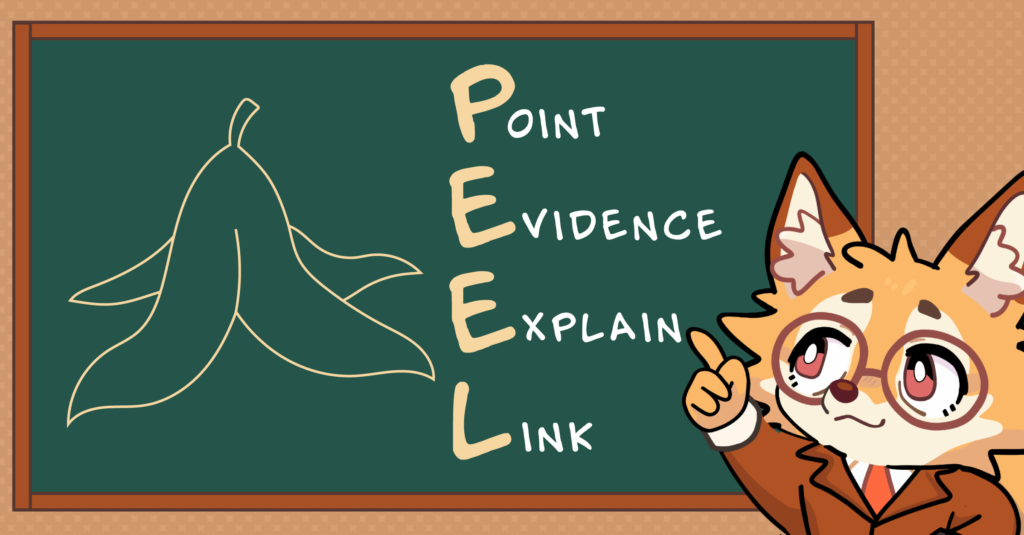
A useful technique is the PEEL method:
- P – Point: Introduce the main idea of your paragraph.
- E – Evidence: Support your point with an example, fact, statistic or other relevant evidence.
- E – Explanation: Explain what the evidence shows and how it supports your argument.
- L – Link: Connect the paragraph back to the essay question or your overall argument.
You can support your arguments using examples, facts, statistics, research findings, expert opinions, and logical reasoning.
IMPORTANT REMINDER! Every paragraph should contribute to the question or main argument of the essay!
- Use Appropriate Vocabulary
One of the most common mistakes among English learners is thinking that a good essay needs complicated vocabulary. But using difficult words unnecessarily can make your writing confusing and sound less natural.
For example, you could write this;
“Education is an indispensable prerequisite for the attainment of personal and professional success.”
Or this;
“Education is essential for achieving personal and professional success.”
You should also use linking words and expressions, known as connectors, to help your ideas flow naturally. Here are some useful examples:
| Purpose | Connectors |
| Adding new information | Furthermore, moreover, in addition, additionally |
| Showing contrast | However, nevertheless, on the other hand, although |
| Expressing consequences | Therefore, consequently, as a result, thus |
| Giving examples | For example, for instance, such as |
| Emphasising a point | Indeed, particularly, especially |
| Expressing an opinion | In my opinion, from my perspective, I believe |
- Review and Edit Your Essay
Once you have finished writing, don’t hand in your essay immediately!
Take a few minutes to read through your work. Pay attention to grammar, spelling and punctuation, vocabulary, paragraph structure, and coherence.
A useful technique is to read your essay aloud. This can help you identify repeated words, or sentences that simply don’t sound natural.
Final Thoughts
Learning how to write a strong essay takes time and practice, but it is a skill that ANYONE can develop.
You do not need to have perfect grammar or an extensive vocabulary to get started. The most important thing is that you organise your ideas, express yourself clearly and keep practising!
Now that you know the steps involved in the writing process of an English essay, why not put them into practice?
Challenge yourself to write a short essay in just 30 minutes! Follow these three steps:
- Plan your ideas (5 minutes)
- Write your essay (20 minutes)
- Review your work (5 minutes)
Here’s a prompt to get you started:
Do you think social media has a positive or negative influence on young people? Discuss both sides and explain your opinion.
Don’t worry about making mistakes, every essay you write is an opportunity to learn something new and improve your English!
Frequently Asked Questions
Q: How can beginners write an essay in English?
A: Practise regularly by writing short essays on things that you are interested in, reading in English and asking for feedback. You can also use resources such as the Royal Literary Fund’s writing guides, Harvard College’s Writing Center, and YouTube tutorials to improve your skills.
Q: How to write an essay without grammatical mistakes?
A: Use simple words and sentence structures that you are familiar with. Once you finish your essay, read it carefully and give yourself time to check everything properly. You can also use online grammar checkers to identify mistakes and learn how to correct them.
Q: What are the most common mistakes when writing an essay?
A: Some common mistakes include going off-topic, repeating the same words or ideas, and failing to organise your arguments properly. To avoid them, plan your essay before writing, focus on one main idea per paragraph and ALWAYS review your work in the end.
Q: How do you start an essay in English?
A: Start by introducing the topic in a way that captures the reader’s attention. You can use a question, an observation, an interesting fact, or even some background information.
Q: How long should the introduction and conclusion of an essay be?
A: This depends on the total word count and the type of essay, but both sections should be shorter than the main body. Roughly, you should dedicate around 10% of your total word count to the introduction, and another 10% to your conclusion, leaving most of your word count to your arguments.