English Learning for Beginners: Words That Get Misspelled Easily
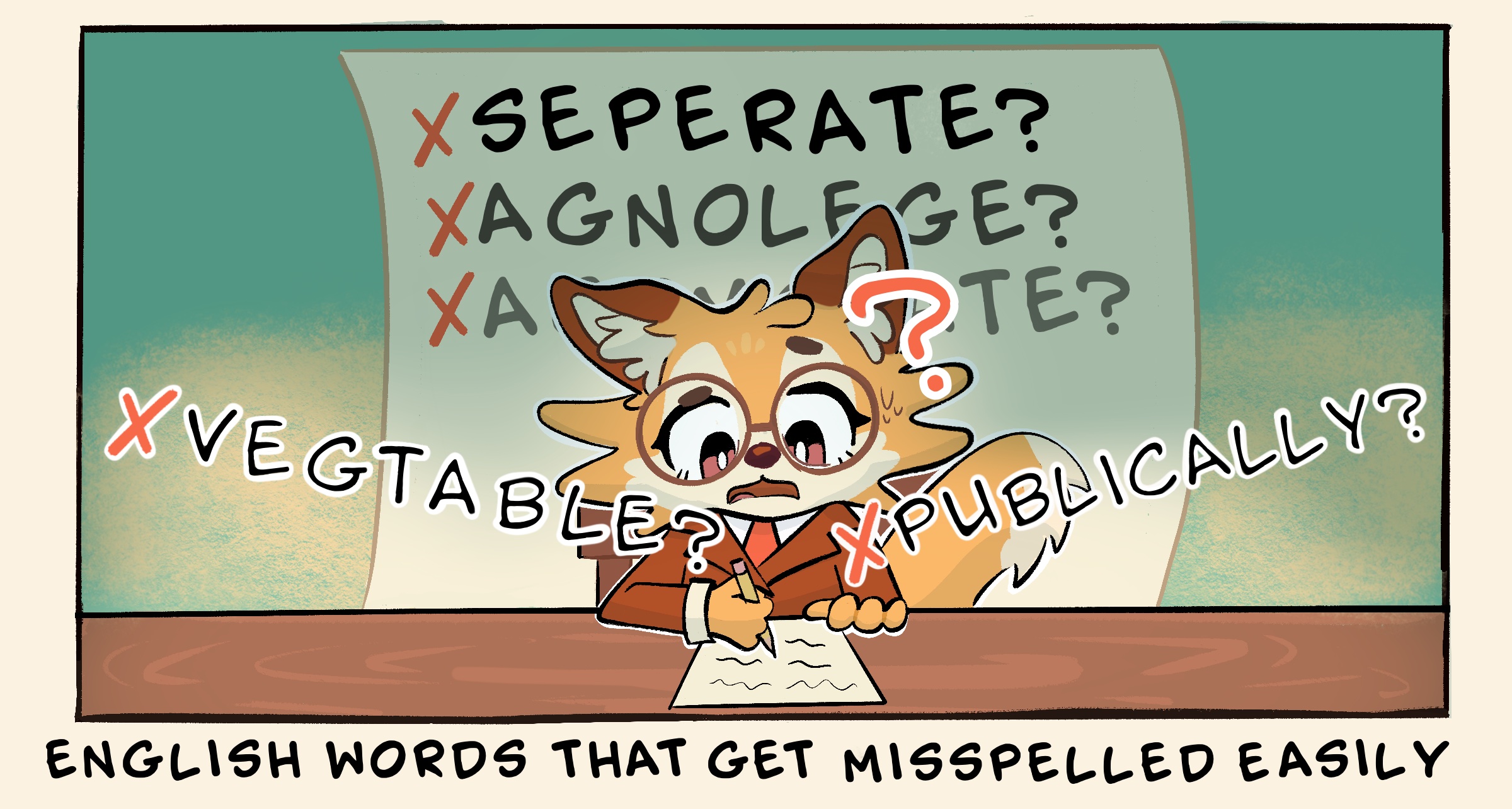
“Vegtable” or “Vegetable?”
“Reccommend” or “Recommend”?
“Wensday” or “Wednesday?”
Some words in English can be difficult to spell correctly. Even native speakers have trouble spelling some tricky words. English learning for beginners and advanced learners will be full of words that are difficult to spell.
In this article, we will go over some commonly misspelled words in English, and what you can do to remember the proper spelling for them.
Words with Unclear Vowels
Some words have unclear vowel sounds, where the vowel sounds like “uh”. This makes it difficult to determine which vowel to use while spelling out the word. Below are some examples:
- Separate – not spelled “seperate” or “separete”. The two middle vowels are both letter “a”‘s.
- Vegetable – sometimes misspelled as “vegtable,” because the “e” in the middle isn’t pronounced clearly in speech.
- Cemetery – not spelled “cemetary”. Although it’s pronounced like that in American English, the correct spelling uses an “e”.
- Existence – sometimes misspelled as “existance”. Remember that “existence” has 3 letter “e”‘s, one at the start, one in the middle, and one at the end.
- Definitely – sometimes misspelled “definately” or “definetely” because the second “i” is often confused for other vowels. Remember that the word “finite” is in the middle of definitely.
Words with Double Letters
Words with double letters, or multiple pairs of double letters can easily be misspelled if you don’t remember which letters are doubled up. Here are some common words with double letters that get misspelled:
- Accommodate – Often misspelled missing a “c” or an “m”. Remember, this word has two c’s and two m’s.
- Vacuum – Sometimes incorrectly spelled with two c’s instead (Vaccum). Remember, it’s two “u”‘s, not two “c”‘s.
- Parallel – Not paralell. The double l’s are in the middle of the word, not the end.
- Embarrass – Sometimes misspelled as “embarass” or “embarras”. The correct spelling has two “r”‘s and two “s”‘s.
- Recommend – Sometimes misspelled as “reccommend” or “reccomend”. Only the letter “m” is doubled.
Words with Silent Letters
Silent letters can be tricky to remember because it makes it hard to spell the words out without having memorized the proper spelling. Here are some common words with silent letters:
- Acknowledge – It can be tricky to remember that “acknowledge” has a “c” and a “k” right next to each other, because they are pronounced as if they are one letter. Keep this in mind when trying to spell this word!
- Acquaintance – The silent “c” in “acquaintance” can easily be missed.
- Wednesday – There are several silent letters in “Wednesday”, which can make it hard for English beginners to spell out. One way to remember the proper spelling is to break the word down and remember it as “Wed-nes-day”.
- Muscle – Not spelled “mussel” or “musle”. The “c” in this word is silent.
- Government – The “n” in the middle of this word is usually silent, causing many people to misspell this word as “goverment”. Remember that “government” contains the word “govern”.
Other Tricky Words
Some words are just tricky to spell correctly for a variety of reasons. English is full of words that don’t make sense or are just easily misspelled by a lot of people. Here is a short list of some other tricky words:
- Privilege – Sometimes misspelled as “privlege,” “privelege,” or “priviledge”. Remember the vowels in this word are two “i”s and two “e”‘s.
- Publicly – Not spelled “publicaly” or “publically”. There is no vowel between “public” and “ly”. The “l” is a single letter.
- Receive – Often misspelled as “recieve”. Remember that “i” comes before “e” except after “c”.
- A lot – Not “alot”. The space between the words can be easily left out by accident while typing. Remember “a” and “lot” are two separate words.
- Weird – Not spelled “wierd.” Usually, “i” comes before “e”, except after “c”, but this word is an exception to the rule. English can be full of exceptions to rules, and this word is one of them!
Frequently Asked Questions
Q: Is there a trick I can use to remember spelling better?
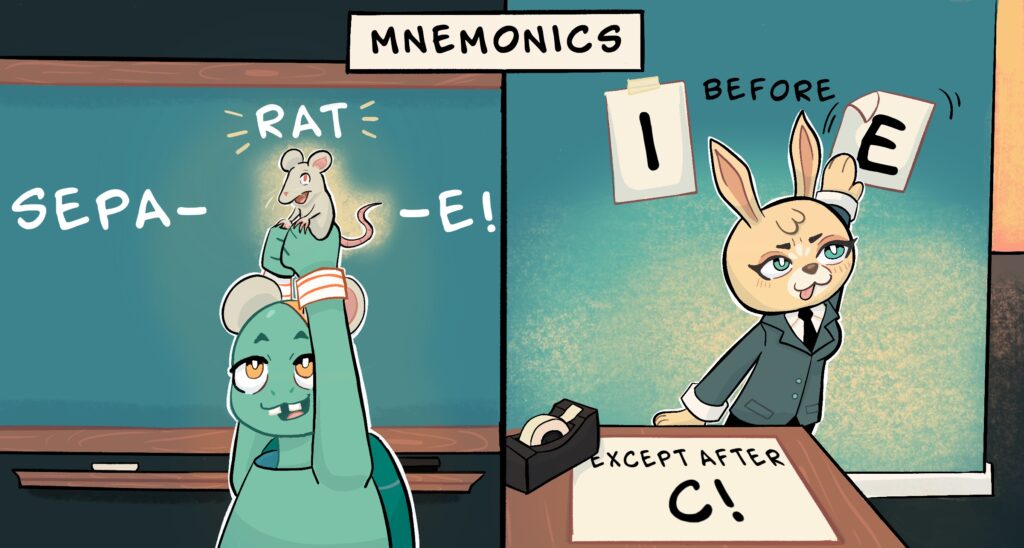
A: Mnemonic phrases are easy-to-remember phrases you use to remember something else. You may have heard of the common English spelling mnemonic phrase, “I before E, except after C”. Here are some other examples you can use:
- Separate: There’s a rat in separate
- Believe: I do not beLIEve a LIE.
- Definitely: Definitely is finite.
- Necessary: Not Every Cat Eats Sardines (Some Are Really Yummy)
- Cemetery: To remember that the word “cemetery” is spelled with three e’s, picture a lady screaming ‘e-e-e’ as she walks past the cemetery.
Try making your own mnemonic phrases to help you remember difficult words!
Q: What are some ways I can get better at spelling?
1. Write words out by hand
A great way to memorize tricky word spelling is to write them out by hand. Writing things out by hand helps you remember them better. If there’s a word you have a hard time spelling properly, try writing it down in a notebook 15 times.
2. Read, read, read!
This may sound like a very simple trick, but reading is a great way to get better at spelling and improve your English overall. The more you read difficult words, the more you get used to how they look, so you will be able to spot when a word is spelled wrong.
Q: How are English words formed?
A: Most words in English are based in Latin, Greek, or French and follow a certain structure. Learning word roots can help you become better at spelling because you’ll know the building blocks for English words. This may sound complicated, but it is easier than it sounds and will improve your English learning by a lot!
Try asking your English teacher or doing some of your own research on English word structure and word roots.
Q: Will an English teacher help me learn better spelling?
A: An English teacher or tutor can give you a structured way to learn English in a way that matches your learning goals. Whether it is an English speaking course online, or an in-person classroom, a teacher can help you in many ways. If you have a teacher already, try asking him or her to help you with English spelling.
Here at English Language and Literature, we have English tutors who would be happy to help you with any of your English learning goals. Book a session today!
Writer: Christina
Designer: Ash Gerasimovich