Who vs Whom: Master the Grammar Rule Everyone Gets Wrong
Why is English so Hard to Pronounce?
Have you ever struggled when trying to pronounce certain English words?
One of the biggest challenges that learners encounter is understanding the relationship between spelling and sound. Unlike more phonetic languages, like Spanish or German, English is often pronounced entirely differently from the letters on the page.
English learners who have previously learned from textbooks, and haven’t taken many English speaking courses, might struggle with pronunciation. In order to help with this, we must first ask:
Why is it that certain English words have such strange spelling? And are there any rules that we can follow to help us know which is the right way to say something?
In this article we will briefly go through the origins of the English language, and look at some important historical influences. We will also explain some of the most commonly mispronounced word groups and identify trends that can help us improve our pronunciation.
Whether you’re a beginner or already taking advanced English speaking courses, this article will help you better understand the complex dynamic between spelling and sound in English.
Introduction
Have you ever struggled when trying to pronounce certain English words?
One of the biggest challenges that learners encounter is understanding the relationship between spelling and sound. Unlike more phonetic languages, like Spanish or German, English is often pronounced entirely differently from the letters on the page.
English learners who have previously learned from textbooks, and haven’t taken many English speaking courses, might struggle with pronunciation. In order to help with this, we must first ask:
Why is it that certain English words have such strange spelling? And are there any rules that we can follow to help us know which is the right way to say something?
In this article we will briefly go through the origins of the English language, and look at some important historical influences. We will also explain some of the most commonly mispronounced word groups and identify trends that can help us improve our pronunciation.
Whether you’re a beginner or already taking advanced English speaking courses, this article will help you better understand the complex dynamic between spelling and sound in English.
The Multiple Origins of English
In order for us to understand why English pronunciation can be so confusing, we must look back at the history of the language.
English is derived from many different languages and therefore follows a mixture of all their rulebooks.
Its earliest form – Old English – was brought over by Germanic-speaking settlers. Although Old English sounds very different to the English we speak today, words such as house, bread, and mother have their origins in this ancient language. It was largely phonetic, that is, words were spelled more or less the way that they sounded.
With the Norman Conquest in 1066, the French language became the language of the ruling classes. This explains why many words to do with government, law, food, and culture have French origins. Some examples are: parliament, executive, justice, court, ballet, hotel, beef, pork.
Fun Fact: The English language uses different words for when an animal is alive or when it is meat, that is, to be consumed as food. For example, a cow will be referred to as beef and a pig will be referred to as pork.
This is because the noble classes were French-speaking, and it was the nobility that could afford to put meat on the table. The “commoners” were English speaking, and continued to refer to the animals by their Germanic names.
Lastly, English was also influenced by Latin, both through the Norman-French connection but also through the church, scholarship, and science. Some examples of words that have their origins in Latin are: scrutiny, data, ego, fact, ignorance, and monster.
You can read more about the history of the English language here: A Brief History of the English Language.
As a fusion of all three languages, English brought together different spelling conventions and pronunciation patterns. This explains why the English language does not always follow one consistent set of rules.
Another important note is that pronunciation has continued to shift over time, whereas spelling has stayed fairly consistent since the invention of the printing press. This has meant that in some cases, pronunciation has drifted further away from its phonetic spelling.
So what are the most common examples of this? If you are already attending English speaking courses or are thinking of doing so, these next tips and trends will help you with your English speaking.
The Mismatch Between Spelling and Sound
Silent Letters
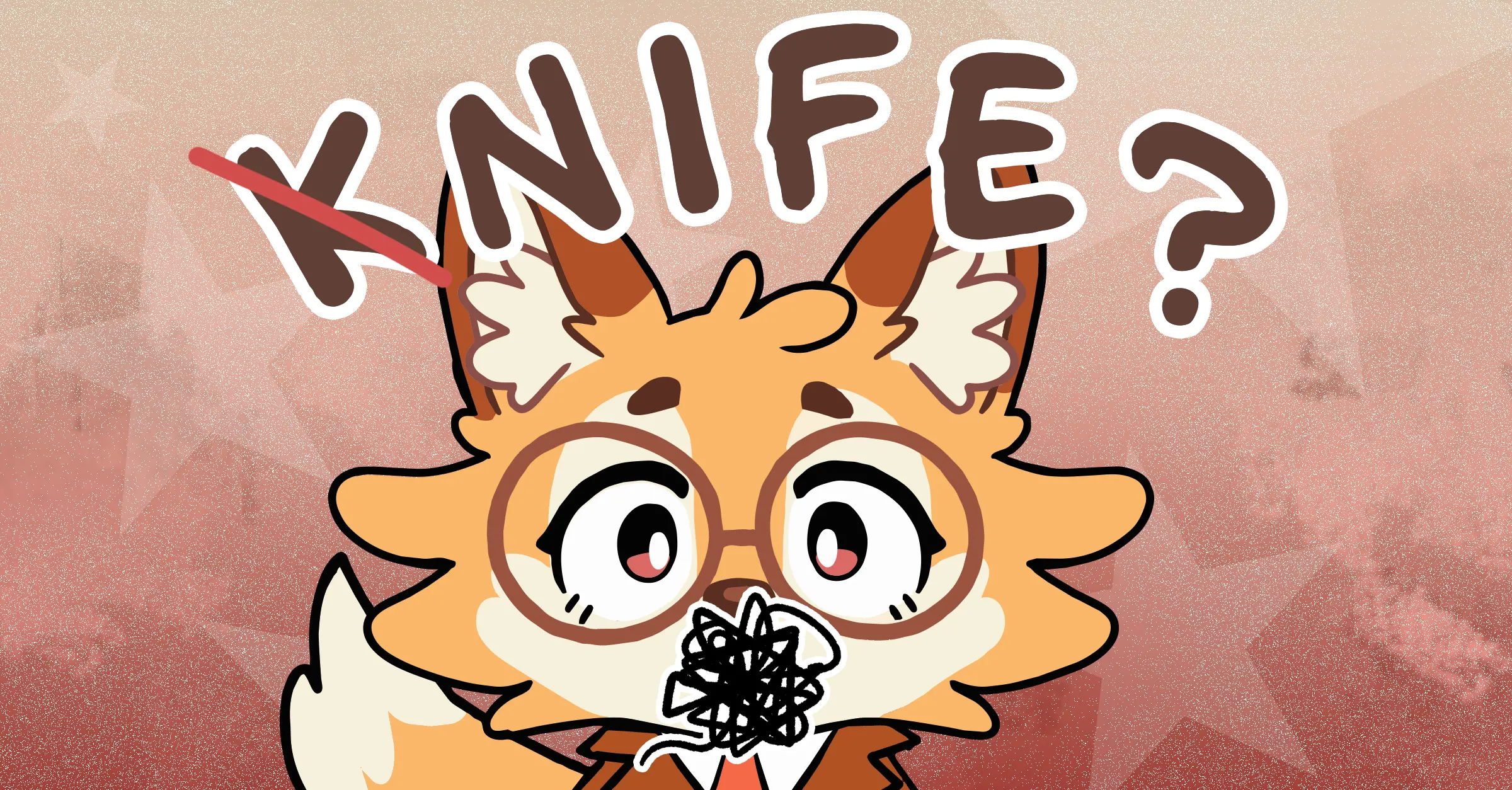
Have you ever wondered why there is a k in knife, a b in debt, or an s in island when these are completely silent?
These silent letters – tricky for beginners and advanced learners alike – are rooted in the different historical origins of English. Although this makes learning harder, it’s also a little window into the word’s past!
The k in knife comes from the Old English word cnīf, where the k sound would have been pronounced. Over time, English speakers stopped pronouncing the k sound at the beginning of these words, but the spelling remained largely unchanged.
The same pattern appears in other words beginning with kn, including knot, know and knock.
The b in debt or doubt was purposefully introduced to show how these words connected to their Latin roots. English speakers had never previously pronounced the b in these words, but it was added to reflect their etymological origins. Debt came into English through Old French, ultimately from the Latin word debitum. Similarly, the spelling of doubt was influenced by Latin dubitare.
The s in island is another example of a letter that was introduced into spelling for historical reasons. The word originally came from Old English īegland. Its spelling was later influenced by the word isle, which came through French from Latin.
Although the s appeared in the spelling, it was never part of the word’s original pronunciation.
Not all silent letters follow the same pattern or were introduced for the same reason. Some were lost in pronunciation over time, whereas others were added in specifically to show their historical origins.
Why Does ‘OUGH’ Have So Many Different Pronunciations?
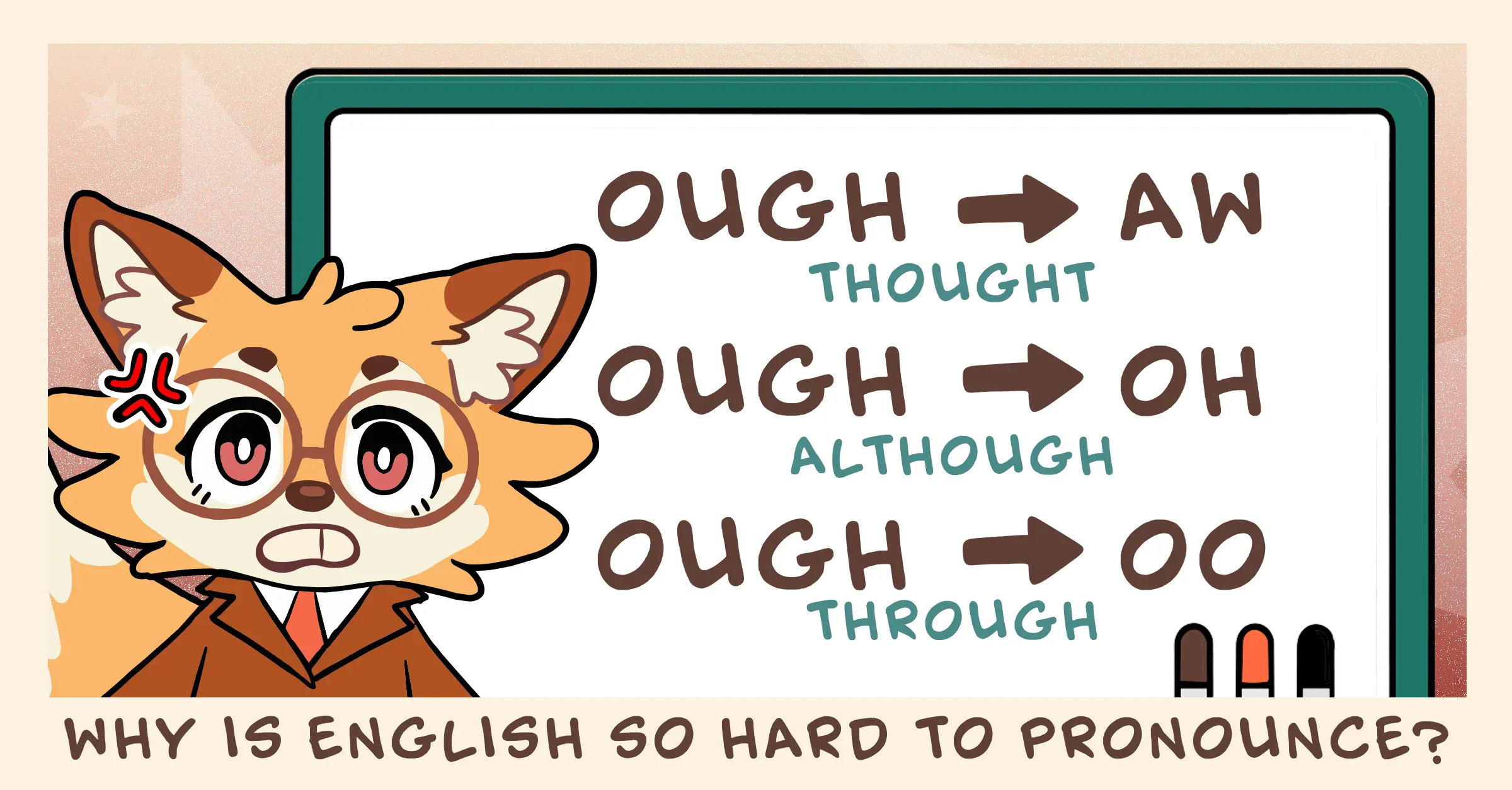
If there is one spelling pattern that demonstrates how unpredictable English pronunciation is, it is ough.
Although these four letters appear together in several common words, they can represent a surprising variety of sounds.
For example:
| Word | Pronunciation of ‘ough’ |
|---|---|
| Though | Sounds like the ending of go |
| Through | Sounds like the vowel sound in blue |
| Thought | Sounds like the vowel sound in caught in accents that distinguish these vowels |
| Tough | Sounds like the vowel in cup |
| Cough | Sounds like the vowel in off in accents with that vowel |
| Bough | Sounds like the ending of now |
| Thorough | Has a different pronunciation depending on the accent, with the ough representing a sound similar to the one in sorry in many British accents |
So, why does the same combination of letters have so many different pronunciations?
Words such as through, though and tough originally had different spellings and sounds in Old English (þurh, þēah and tōh). As English pronunciation and spelling evolved, these words began sharing the same combination of letters, despite representing different sounds.
Unfortunately, there is no pattern or rule to learn the spelling of these words. The best thing to do is revise the most common examples above, and practice them in your English speaking courses.
But don’t worry about getting these wrong. Even for those taking advanced English speaking courses, these might still be confusing. Try to use them. Make mistakes. It’s all part of the learning process.
Unique Sounds and Stress Patterns
Stress-Timed English
Languages are either syllable-timed or stress-timed. In syllable-timed languages, all the syllables in a sentence last for the same amount of time. In stress-timed languages, certain syllables that appear at regular intervals during a sentence are elongated and as a result, the others become squashed, making them sound shorter.
English is a stress-timed language. It can be difficult to know which syllables to stress, as there are no definitive rules. Generally, it is the words in a sentence that carry the most meaning where the vowels are stressed. For example, the main nouns, verbs, adjectives and adverbs.
Below are some examples that show which words and their syllables would be stressed:
- He BOUGHT a new PHONE yesterday.
- I’m LOOKING for my KEYS.
- He WORKS in a RESTAURANT in LONDON.
- THOUGHT you were COMING to the PARTY.
- Could you PASS me the WATER, please?
- We’re GOING to the BEACH tomorrow.
Useful Tip: Like many aspects of learning a language, the best way to master stress-timed English is practice. Next time you hear a native speaker having a conversation, whether in real life or on TV, try to focus on which of the syllables they put emphasis on. You could even write down the sentences and underline all the words with emphasis. This will help you identify speech patterns which you can then transfer to your own pronunciation.
The Schwa Sound /ə/
The schwa sound is the most common vowel sound in English, and has even been given its own name. If there are multiple vowels in an English word, the schwa sound is likely to replace one or more of them. It can correspond to any of the vowels and is pronounced as weak and unstressed.
The schwa sound is also commonly used in function words such as to, a, the, and of. As English is a stress-timed language, we tend to emphasise the most important words in a sentence, while function words are often unstressed and pronounced with the schwa sound.
So what does the schwa sound sound like? The name is quite misleading. Think of it as kind of like a flat a sound, or like the sound English people make when they don’t know what to say similar to ‘uh’.
Below are some examples of the schwa sound and where in the word it would appear:
| Word | Where | Phonetic Spelling |
|---|---|---|
| About | /ə/ at the beginning | ə-BOUT |
| Today | /ə/ at the beginning | tə-DAY |
| Support | /ə/ at the beginning | sə-PORT |
| Teacher | /ə/ at the end (in many British accents) | TEACH-ə |
Conclusion
English is known for its relatively easy grammar, but when it comes to pronunciation, there are definitely some challenges.
Due to its complex history and its roots in Germanic, French, and Latin languages, English has become a cultural melting pot with no easy rulebook to follow.
In this article, we have gone through some of the most common pronunciation pitfalls and tried to give some tips and tricks on how to overcome these.
However, some of the difficult examples above, such as the ‘ough’ sound or the ‘schwa’ sound are simply a matter of practice. Don’t worry though, getting things wrong is all part of the process. In fact, making mistakes and being corrected whilst speaking a foreign language is more likely to help you remember the proper pronunciation for next time!
So don’t be shy and give these difficult techniques a go. Make a list of all the ones you find most challenging and try utilising them in your next English conversation or during your English speaking courses!
Frequently Asked Questions
What are the most difficult things in English for non-native speakers to pronounce?
Words with silent letters, unusual vowel combinations, and tricky consonant groups can be particularly challenging. English also has sounds that don’t exist in other languages (such as th), which can take extra practice to master.
Does pronunciation vary greatly across different forms of English and which one should I learn?
Yes! British, American, and Australian English can differ in their pronunciation of certain words. The best approach is to choose the variety you encounter most often and practise being consistent with it.
What is the best way to practice my English pronunciation?
Try listening to English speakers, recording yourself, and repeating phrases aloud. You can also practise with friends or in English classes to build your confidence.
Is English more closely related to its Germanic or Latin roots?
English is primarily a Germanic language, although it has borrowed many words from Latin and French. This mixture is one of the reasons why English spelling and pronunciation can be so unpredictable.
What if I keep getting my English pronunciation wrong?
Don’t worry! Making mistakes is a natural part of learning a language. Keep practising, listen to native speakers, and don’t be afraid to speak. The more you practise, the more confident you’ll become.
Table of Contents
- Introduction
- The Multiple Origins of English
- The Mismatch Between Spelling and Sound
- Unique Sounds and Stress Patterns
- Conclusion
-
Frequently Asked Questions
- What are the most difficult things in English for non-native speakers to pronounce?
- Does pronunciation vary greatly across different forms of English and which one should I learn?
- What is the best way to practice my English pronunciation?
- Is English more closely related to its Germanic or Latin roots?
- What if I keep getting my English pronunciation wrong?
Written by: Lisa Richardson