How Social Media is Changing the English Language
Introduction
Social media is changing the English language faster than any other force in modern history.
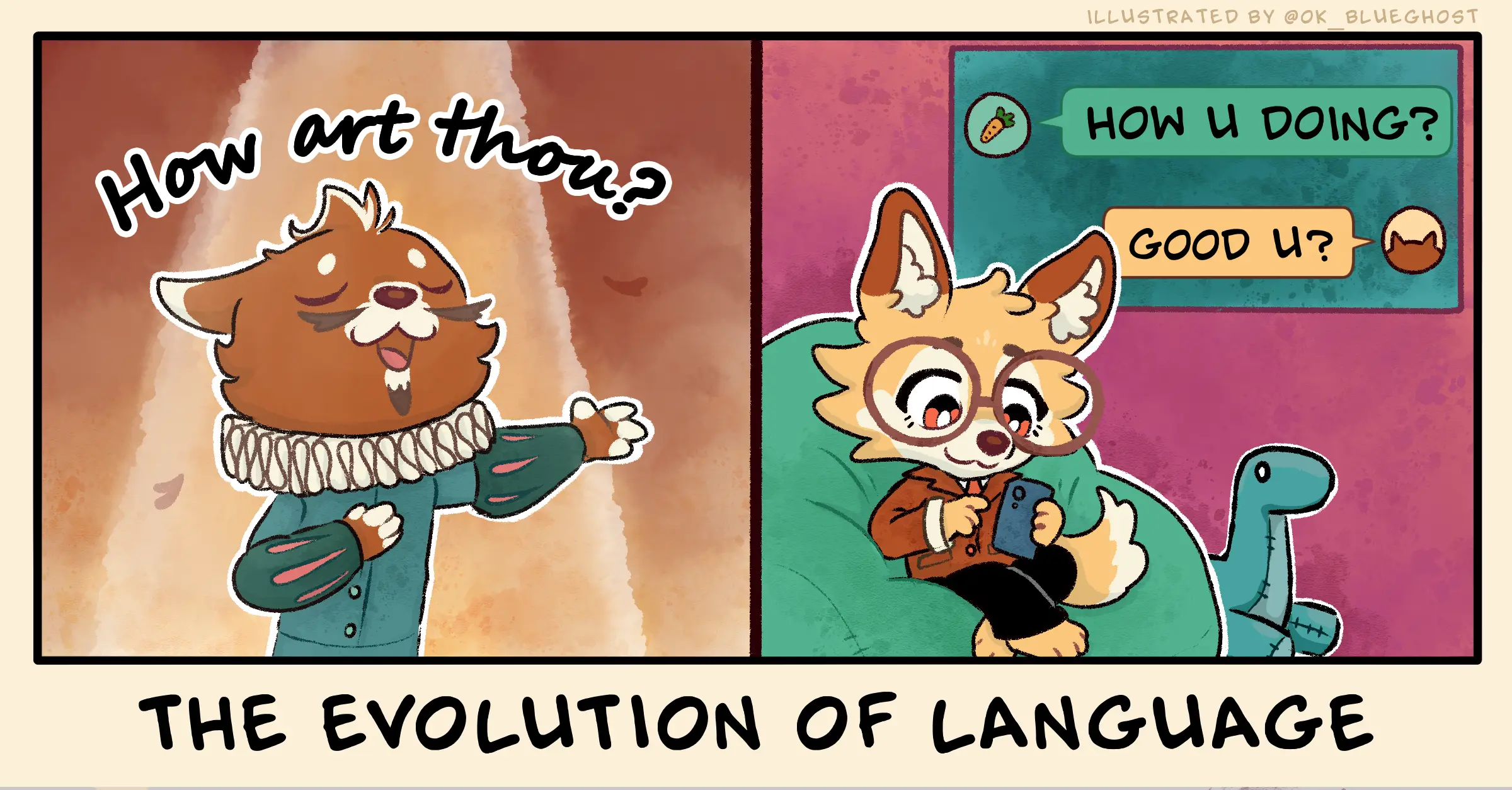
Language has always been fluid and will continue to change over time. For example, Shakespearean English is totally different from modern English, and although they share many words, it would be a bit bizarre if someone asked you “How art thou?”
But with the rise of technology, language is changing faster than ever. New viral trends emerge almost daily, and the internet’s language follows suit.
Social media has changed the way we communicate – this is the same with all languages. Whether it is the Latinx debate around gender neutral language or Germany’s heavy use of Denglish, social media is changing language everywhere. You can explore how American and British English differ as another fascinating example of how language evolves differently across communities.
This can be difficult if you are trying to gain access to the English-speaking internet community and are constantly confused by what the latest phrases mean. In this article, we will try to give you the basics of contemporary English social media slang, so that next time you scroll on Instagram, you feel like you are also getting the jokes!
In order to sound like a true native online, it’s time to leave your textbook English to one side and get into the nitty-gritty of internet language.
If you’re taking the best english speaking course online for your specific needs, it should also help you understand how English is actually used in everyday conversations, rather than just teaching you grammar and vocabulary from a textbook.
This article will focus on specific examples that will help you to understand specific social media slang to allow you to communicate naturally online. Alongside this, we will explore why this language shift is happening in the first place, and the potential pitfalls that we should watch out for.
Table of Contents
- Introduction
- Viral Words and Phrases
- A Whole New Language
- Abbreviations and Images
- Generational Gaps
- Conclusion
- Frequently Asked Questions (FAQs)
Viral Words and Phrases
We live in an age where the internet has the power to make words and phrases go viral. Suddenly, everyone’s using the same few turns of phrase, or at least know what they mean.
New trends emerge almost daily and with them a whole set of accompanying vocabulary.
Not only do niche words enter our daily lives, but sometimes the original meaning of the word also changes. Take “it’s giving”, for example. Giving generally means to physically transfer something to someone else. But in internet culture, giving refers to a specific vibe or mood. This is similar to how many English words get mixed up easily when their meanings shift over time.
The rise and fall of these words can happen so quickly, so don’t worry if you end up using a phrase that is slightly outdated.
If you’re taking an English language course online, you can also use social media as a way to practise outside your lesson! Pay attention to the words and phrases native speakers are actually using and make a note of any that you don’t recognise.
But keeping up with the latest social media slang will impress fellow English speakers and avoid the risk of sounding like a boomer (a slang term for someone from an older generation who can’t keep up with modern life).
The examples provided below are some of the most recent viral words and phrases on the internet. You can also explore our list of behaviour idioms in English to further enrich your vocabulary beyond slang.
| Word/Phrase | Meaning | Example |
|---|---|---|
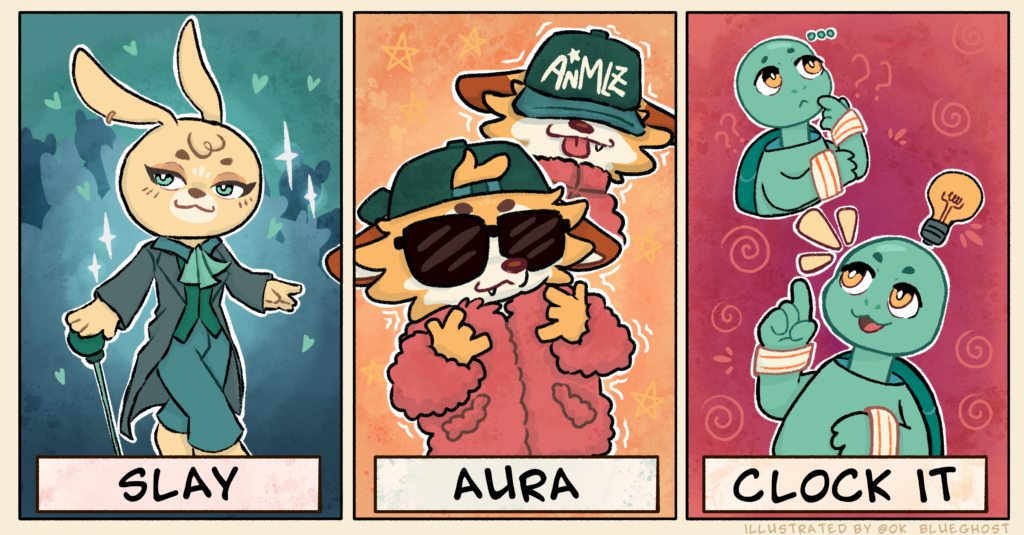
| Aura | Someone’s effortless coolness, confidence and charisma | “Did you see how he entered the room? His aura is unmatched.” |
| Rizz | Someone’s ability to flirt or charm successfully. | “I have zero rizz. I got my crush’s name wrong.” |
| Clock it | To realise or agree with something. | “That film was a disaster” “Clock it.” |
| It’s giving | A way to describe a specific vibe or mood. | “He won’t leave me alone. It’s giving desperate.” |
| Demure | Acting with exaggerated grace. | “His attitude at work is so professional. Very demure, very mindful.” |
| Slay | To do something exceptionally well. | “Your outfit is so slay right now.” |
Some phrases and words, such as “slay”, originated from marginalised communities such as the LGBTQI community or Afro-Caribbean cultures and have since become viralized.
Some other examples include “cap” which means to lie, “ate” which can be used to describe someone doing something well, and “clock it” which means to realise something.
Although language spreading and changing is not something controllable, and using these phrases can be a way to show solidarity, it is worth treading with caution as it could risk cultural appropriation or dilution.
Useful tip: If you’re looking for the best English speaking course, look for one that focuses on practicing real-life conversations and scenarios as this will be useful for real world application.
A Whole New Language
A whole new language has developed with the rise of social media. These words are deeply ingrained within the younger generations’ vocabulary and come up more often than you think.
Because social media has become such an integral part of modern life, conversations often revolve around the online word. Make sure you know these next words, otherwise you might be totally lost in conversation!
Here at English Language & Literature we offer advanced English speaking courses that can help you practice these modern social media phrases and integrate them into everyday conversation.
| Word | Meaning | Example |
|---|---|---|
| Follow | To subscribe to user’s account so that their updates appear on your feed. | “I started following a chef on instagram and I’ve learned so many recipes.” |
| Tag | To attach another user’s profile to a post. | “Make sure to Tag me in that photo.” |
| Block | To permanently restrict someone from seeing your profile or interacting with it. | “I had to block that account because it was a spam account.” |
| Like | To interact with a piece of content by clicking a button that shows you “like” the post. | “I don’t know that girl, but we always like each other’s photos on Instagram.” |
| Post | To publish videos, texts, or photos for other people to see. | “She posted about her graduation on LinkedIn.” |
| Shadowban | To block an account from the digital community by limiting how much their content can be visible to others. | “No one is liking my TikToks anymore, I think I’ve been shadowbanned.” |
Abbreviations and Images
Modern society often communicates ideas through images rather than strictly through text. The use of GIFs, emojis, and images is now an integral part of the English language.
Rather than giving a detailed description of their holiday to Greece, your best friend might post a slide show of her top 10 highlights with a caption like “this is the life”. She might even accompany this caption with a palm tree or sun emoji.
This has changed the way that we use language in the digital community – rather than being the main event, language is often secondary to images.
Even when it comes to news, captions on Instagram posts or TikTok videos have become many younger generations’ main sources of information. In order for people to be interested, the caption must be engaging and get straight to the point. As such, social media is shaping our online language – simple, bold, and to the point.
Next time you’re writing a caption, bear these tips in mind. The most important thing is that your caption is engaging and short. If you want to go further, our guide on how to make your English writing sound more sophisticated is a great next step. The good news is, this may actually be simpler than other forms of English, so you’ll master it in no time.
If you are communicating over text or on social media, many people use abbreviations whose meanings are by now common knowledge.
Learning these will both help you blend in and also save you time typing. After all, in modern society, time is money!
If you’re looking for the best English speaking course, remember that improving your English isn’t just about learning new words. Understanding how people communicate casually is just as important. Our tips on improving spoken English can complement what you’re learning here.
| Abbreviation | Meaning |
|---|---|
| LOL | Laugh out loud |
| IDK | I don’t know |
| TBH | To be honest |
| NGL | Not going to lie |
| IKR | I know right |
| RN | Right now |
| BTW | By the way |
| LMK | Let me know |
| ASAP | As soon as possible |
| BRB | Be right back |
Useful Tip: An English language course online can give you a structured way to build your vocabulary, but practising through social media can help you see how these words and abbreviations are used in real life. As we’re all already on our phones way too much, use this as an opportunity to improve your English!
Generational Gaps
The internet community has become obsessed with the difference between generations, and how this affects intergenerational communication. This new differentiation has itself become a trend, and something that everyone is talking about.
This is especially relevant in terms of social media and slang, as there is now a big difference between who understands this new form of language, and who doesn’t.
Below, we’ve included some of the most recent generations that often appear in internet discourse.
Next time your friend says something like “Yeah, but don’t ask him about music, he’s a millennial” you’ll know exactly what they’re getting at. Understanding generational differences in language also ties closely into how immersing yourself in English through everyday life helps you stay current.
| Generation | Known for |
|---|---|
| Generation Beta (2025 – 2039) | Only just being born. Predicted to be a generation of AI. |
| Generation Alpha (2013 – 2024) | Known as “iPad kids” due to having access to iPads from infancy. |
| Generation Z (1997 – 2012) | Coined and mainstreamed internet terminology. Big social media presence. |
| Millennials (1981 – 1996) | Grew up during the rise of the internet. Known for things such as hustle culture and self-care. |
This is why we would recommend an advanced English speaking course as it can be useful for learners who already have a strong grasp of grammar but want to become more comfortable with the slang used by native speakers.
Conclusion
Social media has undoubtedly changed the way we communicate, and the English language is no exception. From viral slang and abbreviations to emojis and images, the way we express ourselves online often feels like a language of its own (which in some sense it is).
You don’t need to know every new piece of slang to communicate effectively. Understanding some of the most common words, phrases, and abbreviations can simply make it easier to follow conversations and feel more comfortable in online spaces.
It is also important to remember that internet language is constantly changing. What sounds trendy today might sound completely outdated in a few years. If you want to understand how words evolve and deepen your English fluency, exploring the origins of English words is a great place to start.
So, the next time you come across a phrase you don’t understand on TikTok or Instagram don’t panic. Look it up, learn what it means, and try to use it in your online communities.
If you want to take your English further, finding the best English speaking course for your level will help you become more confident practicing the informal language we have been through today.
Frequently Asked Questions (FAQs)
What is social media slang and why is it important to learn?
Social media slang refers to informal words, phrases, and abbreviations that have emerged from platforms like Instagram, TikTok, and Twitter. Learning it is important because it helps you communicate naturally with native English speakers online, understand trending conversations, and avoid sounding outdated. If you’re taking an English language course online, understanding social media language can bridge the gap between textbook English and real-world communication.
How is social media changing the English language?
Social media is accelerating language change by making new words and phrases go viral almost instantly. Words like “rizz”, “slay”, and “it’s giving” have entered everyday conversation within months of appearing online. Social media also shifts how we use language – favouring shorter, more visual communication through emojis, GIFs, and abbreviations like LOL and TBH. This speed of change is unprecedented in the history of language evolution. Learn more about how English words can change meaning over time.
What are the most common English abbreviations used on social media?
Some of the most common English abbreviations used on social media include: LOL (Laugh out loud), IDK (I don’t know), TBH (To be honest), NGL (Not going to lie), ASAP (As soon as possible), BTW (By the way), LMK (Let me know), IKR (I know right), RN (Right now), and BRB (Be right back). These abbreviations are widely used across platforms and are considered common knowledge among English speakers online. Mastering these is a key step in improving your spoken and written English.
Is social media slang appropriate to use in formal English or academic writing?
No, social media slang and internet abbreviations are not appropriate in formal English, academic writing, or professional communication. They are meant for casual, informal online conversations. One of the key skills taught in any good English language course online is knowing when to use formal versus informal language. Understanding both registers – formal and informal – makes you a more versatile and effective communicator. Our guide on writing sophisticated English is also a useful resource here.
How can English learners keep up with constantly changing social media language?
The best way for English learners to keep up with evolving social media language is to actively engage with English-language content on platforms like TikTok, Instagram, and X (Twitter). Make note of unfamiliar words and look them up using resources like Urban Dictionary. Combining this with a structured English speaking course gives you both the foundation in grammar and the real-world exposure needed to understand how English is actually used in 2024 and beyond. You can also explore our tips on immersing yourself in English through everyday life for more practical ideas.